

Disclosure: We may earn a commission from qualifying purchases made through affiliate links, at no extra cost to you. As an Amazon Associate I earn from qualifying purchases.
Putting your phone away and switching off the lights may help you wind down, but that doesn’t always mean you’ll wake up feeling well rested. If you’re considering grounding sheets, you may be looking for a simple way to support better sleep without adding another step to your nighttime routine.
That’s where BareEarth grounding sheets come in. In this Bare Earth grounding sheets review, I take a closer look at the silver-thread cotton design and how you can incorporate it into your existing bedding.
I’ll also explain how skin contact works and what current research says about grounding sheets and sleep. From there, I’ll cover sizing and show you how to use BareEarth grounding sheets with the bedding you already have.
What Are BareEarth Grounding Sheets?
BareEarth grounding sheets are fitted bed sheets woven with conductive silver threads. A grounding cord connects the fabric to a properly grounded outlet or grounding adapter, with direct skin contact providing the connection between the body and the sheet.
The full-bed design makes grounding part of the bedding, giving an exposed arm or leg more room to stay against the conductive surface as sleeping positions change.
Cotton and Conductive Silver Threads
BareEarth describes its sheets as organic cotton with a 10% silver-thread blend and a 400 thread count. The cotton forms the fabric, while the silver threads provide its conductive path when connected to ground.
The 10% silver figure refers to the amount of silver thread woven into the fabric.
Sizes, Colors, And Mattress Fit
BareEarth’s fitted grounding sheets have a 15-inch pocket depth across all the sizes listed in its chart. For a pillow-top mattress or a mattress with a thick topper, measure the total mattress height and make sure it fits within that 15-inch pocket depth.
| Size in BareEarth’s chart | Width × length | Pocket depth |
|---|---|---|
| Single | 39 × 75 inches | 15 inches |
| Twin XL | 39 × 80 inches | 15 inches |
| Double | 54 × 75 inches | 15 inches |
| Queen | 60 × 80 inches | 15 inches |
| King | 76 × 80 inches | 15 inches |
| California King | 72 × 84 inches | 15 inches |
Going from a Queen to a King only adds extra fabric across the bed and doesn’t fix the depth issue.
BareEarth offers four colors (Chateau Ivory, Obsidian Grey, Scribe Blue, Verdant Sage), so there’s room to coordinate the sheet with existing bedding.
Place the grounding sheet over the mattress protector so your bare skin can touch the conductive fabric. BareEarth says direct skin contact is needed, so don’t put a regular fitted sheet over it. A top sheet or comforter can still go over you as usual.
How To Use The BareEarth Grounding Sheet
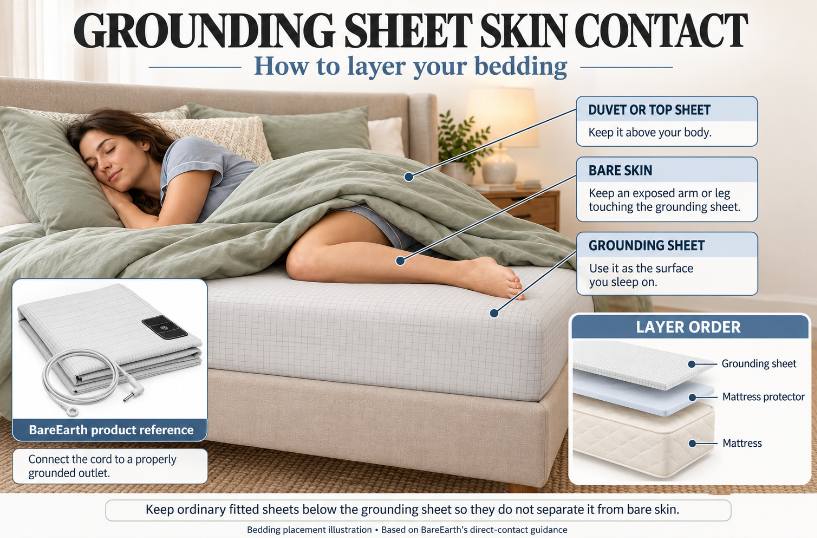
BareEarth’s instructions explain how to position the conductive fabric and connect the cord. Start with the bedding arrangement so the sheet remains accessible to bare skin.
Direct Skin Contact and Bedding Layers
Use BareEarth as the fitted sheet, with the mattress protector underneath. Some bare skin needs to touch the conductive fabric, so an ordinary fitted sheet shouldn’t cover it.
A top sheet or duvet can remain above the body. If pajamas cover most of the skin, an exposed arm or leg should stay against the grounding sheet during sleep.
If you currently sleep on a regular fitted sheet, the grounding sheet will need to replace it as the surface you sleep on. You can keep the rest of your bedding as long as some bare skin stays in direct contact with the grounding fabric.
Connect the Cord to a Verified Ground
Lay the sheet with its conductive silver side facing up. Attach the cord to the snap connector, then connect the other end to a properly grounded outlet or grounding adapter.
Use an appropriate tester according to its instructions to check the ground connection. A three-slot outlet doesn’t confirm that the wiring behind it is correctly grounded. If the result is unclear, have a qualified electrician check the outlet; the Electrical Safety Foundation International explains grounded receptacles in its outlet guide.
Route the cord with enough slack to avoid pulling on the sheet’s connector. Keep it clear of walking paths so getting into bed doesn’t mean stepping over it.
What Does Grounding Research Say About Sleep?
A 2025 randomized, double-blind, placebo-controlled pilot study followed 60 participants who used either a grounding mat or a non-grounding comparison mat for six hours a day over 31 days.
The grounding group showed improvements in several sleep and stress measures, including more total sleep time compared with the control group. Because the other group used a similar mat without grounding, researchers could compare grounding itself rather than simply comparing a mat with no mat at all.
These findings are still early. The study was small, lasted only 31 days, and tested grounding mats rather than BareEarth sheets. Even so, the results suggest that using grounding as part of bedding may have potential.
Grounding Sheets Vs. Mats: Which Format Suits Bedtime?
A grounding sheet covers most or all of the mattress, providing a larger conductive surface during sleep. That leaves more room to change positions while maintaining bare-skin contact.
A grounding mat covers a smaller area and can be placed on part of the bed, under your feet at a desk, or in another spot where direct skin contact is practical.
I’d favor a sheet for grounding throughout bedtime, particularly if a small contact area would be difficult to stay on. A mat may suit someone who wants to use the same product in different rooms.
For more on how grounding sheets work, including conductive fabric and grounded outlet connections, read my guide to grounding sheets. If you’re comparing grounding sheets, earthing mats, and other grounding products, the best earthing products guide covers different options in one place.
How To Wash BareEarth Grounding Sheets
BareEarth’s care guide recommends machine washing on a gentle cycle with cold or warm water. Use mild liquid detergent and leave out fabric softener.
Bleach and whitening agents should also be avoided because they may damage the conductive fibers. Air dry when possible, or tumble dry on low heat. BareEarth also advises against dry cleaning and ironing.
Regular washing removes body oils and lotions that can affect conductivity. If other bedding is usually washed with softener or dried on high heat, wash the grounding sheet separately.
A spare sheet may be worth considering if bedding is air dried. It allows the bed to stay made while the freshly washed sheet dries.
BareEarth Grounding Sheet Price, Returns, And Warranty
BareEarth offers bundle discounts that lower the price per sheet. A second sheet gives the bed a spare for laundry day, so a bundle may be worth considering. Check the current offer and final order total before purchasing.
The 90-day return window starts at delivery, but the written policy requires sheets to remain unopened and unused in their original packaging. Return shipping is paid by the customer. Read BareEarth’s latest return policy before opening the package.
The standard warranty covers manufacturing defects for 90 days under normal use. An optional extended warranty is available at checkout and provides coverage for one year from purchase. Review the latest warranty terms for exclusions and claim instructions.
Bare Earth Grounding Sheets FAQ
What Are BareEarth Grounding Sheets Made Of?
BareEarth lists organic cotton with a 10% silver-thread blend and a 400 thread count. The silver threads form the conductive part of the fabric.
Do BareEarth Grounding Sheets Need Direct Skin Contact?
Yes. BareEarth’s setup guide and product FAQ specify direct skin contact. Keep some bare skin touching the conductive sheet and leave out another fitted sheet between you and the fabric.
Can I Use A Mattress Protector With A BareEarth Sheet?
Yes, if you place the protector beneath the grounding sheet and keep some skin in contact with the conductive fabric. A protector between your skin and the grounding sheet would interrupt the direct contact BareEarth specifies.
Do BareEarth Grounding Sheets Need A Grounded Outlet?
Yes. BareEarth’s setup guide requires a properly grounded outlet or grounding adapter. Check the ground connection with an appropriate tester, and have a qualified electrician address uncertain wiring.
Can I Machine Wash BareEarth Grounding Sheets?
Yes. Use a gentle cycle, cold or warm water, and mild liquid detergent. Avoid bleach, whitening agents, and fabric softener, then air dry or tumble dry on low heat.
My Take On BareEarth Grounding Sheets For Bedtime
I’d shortlist BareEarth grounding sheets if you want grounding built directly into your bed rather than relying on a smaller mat. The larger conductive surface gives you more room to move during sleep while still keeping some bare skin in contact with the fabric.
Use BareEarth as the fitted sheet, with a favorite duvet on top. The mattress protector belongs underneath, and the cord needs to reach a verified ground connection.
For anyone comfortable with that arrangement, BareEarth is an attractive way to bring grounding into the bedroom. Its four color options leave room to coordinate with existing bedding, so the bed can keep its familiar look.
Product And Research Sources
Product details come from the BareEarth listing, setup instructions, care guide, return policy, and warranty policy. The sleep research is Park et al. (2025); outlet guidance comes from the Electrical Safety Foundation International.